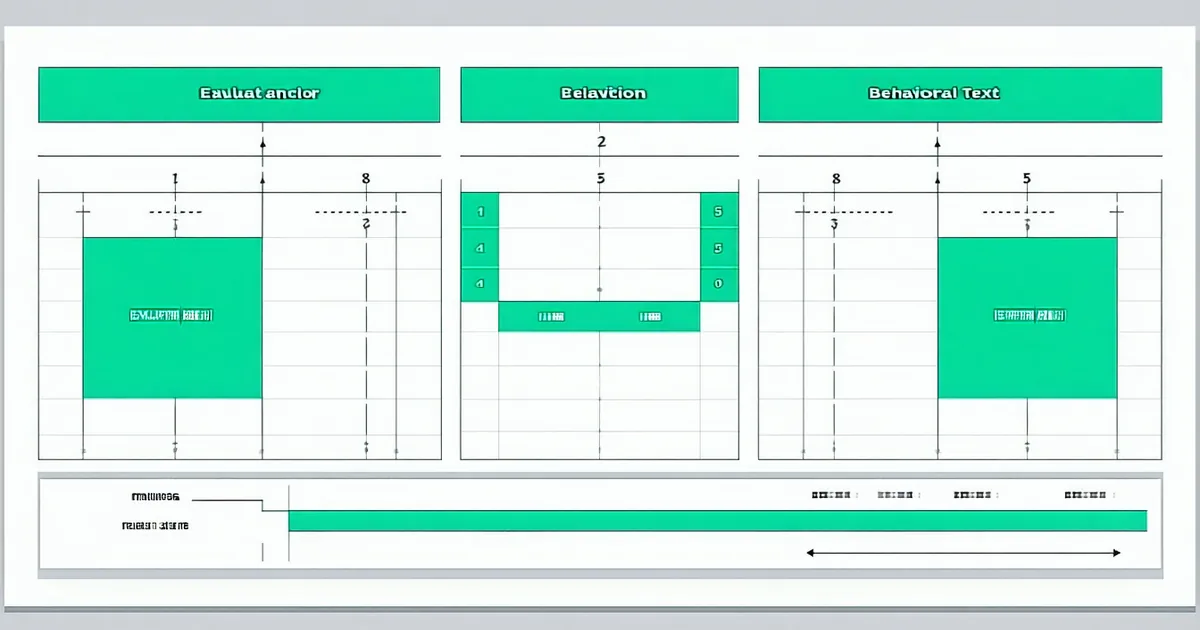
Two interviewers assess the same candidate in back-to-back rounds. One gives her a 4 on cross-functional communication. The other gives her a 2. In the debrief, they each describe their rationale confidently and incompatibly. The hiring manager spends the next forty minutes trying to reconcile the gap, eventually tabling the question and returning to instinct. The candidate — who happens to be strong — is declined because the disagreement was not resolved in her favor.
This is not unusual. It is, in fact, a predictable consequence of running an interview loop where interviewers share a rubric but have never calibrated on what the rubric actually means. The scorecard existed. The behavioral anchors existed. The inter-rater reliability did not.
Interviewer calibration is the practice that closes this gap. It is distinct from training — training teaches interviewers how to conduct a behavioral interview; calibration ensures that multiple interviewers applying the same rubric will arrive at meaningfully similar scores for the same response. Both are necessary. Neither substitutes for the other.
What Inter-Rater Reliability Actually Means
Inter-rater reliability is the statistical measure of how consistently different raters score the same material. In the context of structured hiring, it measures whether two interviewers evaluating the same candidate response against the same BARS-anchored rubric will produce similar scores.
The standard metric is Cohen's kappa coefficient — a statistic that accounts for the agreement you would expect by chance. A kappa of 1.0 means perfect agreement; a kappa of 0.0 means no agreement beyond chance. In hiring contexts, a kappa above 0.60 is generally considered acceptable reliability; above 0.80 is strong. Most interview programs that have not been explicitly calibrated operate well below 0.60.
Low inter-rater reliability is not primarily a problem of interviewer quality. It is a problem of anchor specificity. When two interviewers score a candidate differently on "problem-solving," the most likely explanation is not that one of them is wrong — it is that the anchor language is broad enough to accommodate genuinely different interpretations. The calibration process is the mechanism for detecting and closing those interpretation gaps.
How to Run a Calibration Session
A calibration session is not a debrief. It is a working session that happens before the interview loop goes live, using training material — typically transcripts or recorded responses from prior loops, stripped of identifying information — to align interviewers on anchor interpretation before they score real candidates.
The structure is straightforward. Select three to five candidate responses from previous loops that represent different points on the rating scale for a given competency. These should include clear 5-anchor examples, clear 2-anchor examples, and — crucially — several boundary cases that interviewers legitimately might score differently. Distribute the responses to all interviewers. Ask them to score independently, without discussion, and note their rationale.
Then compare. Where scores agree, acknowledge the agreement and capture the shared interpretation. Where scores diverge, have each interviewer articulate what specifically they saw in the response that drove their score. The goal of this discussion is not to determine who was "right" — it is to discover what interpretation of the anchor each interviewer was operating from, and to either revise the anchor language to close the ambiguity or establish a shared interpretation that all interviewers commit to for the upcoming loop.
A single calibration session — two hours, well facilitated — can materially improve inter-rater reliability for the interviewers in the room. The improvement does not persist indefinitely. New interviewers joining the loop, changing role requirements, and the natural drift of interpretation over time mean that calibration is a recurring practice, not a one-time event.
Calibration Across a Four-Person Loop: A Scenario
An early-stage data infrastructure company was building its first dedicated data engineering team. The hiring loop consisted of four interviewers: the engineering director, a senior data engineer, a product manager from the primary internal customer team, and an engineering peer from an adjacent team. Each interviewer was assigned distinct competencies — the senior engineer covered technical depth, the PM covered communication and stakeholder thinking, the peer covered collaboration, and the director covered the full rubric with bar-raiser responsibility.
Before the first loop went live, the team ran a calibration session on two competencies that had produced score divergence in a previous iteration: "communication of technical concepts to non-technical stakeholders" and "handling of ambiguous requirements." For each competency, they worked through four training responses. On the first pass, the PM and the senior engineer's scores diverged by two points on three of the four responses — large enough to produce systematically different debrief outcomes depending on which frame prevailed.
The calibration discussion revealed the source of the gap: the senior engineer was scoring against whether the candidate's technical explanation was accurate; the PM was scoring against whether the explanation would have been useful to a non-technical colleague. Both are valid interpretations of "communication of technical concepts" — but they are different competencies. The team revised the anchor to specify the audience frame explicitly: "candidate accurately conveys the relevant implications of a technical decision to an evaluator who is assumed to have no engineering background." The next scoring round produced a kappa above 0.70 on that dimension.
Pre-Debrief Scorecard Submission as a Calibration Tool
One of the highest-leverage structural changes a hiring team can make is requiring scorecards to be submitted before the debrief meeting begins. This is not a calibration session — it is a process design choice that produces the raw data calibration depends on.
When interviewers submit scores before discussing the candidate, you capture their independent judgment. This serves two functions: it prevents the conformity effects that cause interviewers to revise their scores in the direction of the first vocal person in the debrief, and it creates a persistent record of where disagreements existed before discussion. The latter is valuable both for EEOC documentation purposes and for ongoing rubric improvement — a pattern of systematic pre-debrief divergence on a specific competency dimension is a signal that the anchor needs sharpening, not that the interviewers are unreliable.
The debrief calibration meeting itself should then begin with a display of pre-submitted scores before anyone speaks. Score divergences above one point on any dimension should be discussed explicitly, with each interviewer presenting the specific evidence from the candidate's response that drove their score. Decisions that override the average score should be documented with the overriding rationale rather than simply replacing the original scores.
Common Calibration Failures
The most common failure mode is treating calibration as a one-time onboarding exercise. A new interviewer attends a calibration session, scores reasonably well, and is deployed in the loop. Six months later, their interpretive drift has diverged from the rest of the team and no one has re-checked. Calibration should be recurring — at minimum when a new interviewer joins, and ideally quarterly for interviewers who are active in regular loops.
A second failure mode is calibrating on the wrong material. If your training responses are all clear-cut cases — obvious 5s and obvious 1s — your calibration session will produce high agreement without exposing the boundary cases where the anchors are genuinely ambiguous. The most useful calibration material is precisely the cases that are hard to score: responses that sit at the 3/4 boundary, responses that are strong on some anchor elements and weak on others, responses where the behavioral evidence is indirect.
A third failure mode is conflating calibration with consensus-building. The goal is not to get everyone to agree on a single score for every response — it is to ensure that score differences reflect genuine differences in candidate behavior rather than differences in anchor interpretation. Some disagreement after calibration is expected and appropriate. Forced consensus is not calibration; it is groupthink with a rubric attached.
Getting calibration right is the difference between a structured interview program that produces the validity improvement the research promises and one that produces structured-looking outputs from a process that still fundamentally relies on gut feel. The rubric is the instrument; calibration is how you tune it.